Finding the word
Information in the dictionary is given in entries, arranged in alphabetical order of headwords. Compound words are in separate entries, also arranged alphabetically.
Some headwords may have more than one part of speech.
Parts of speech are displayed below the entry. Where the headword has multiple parts of speech, each one is displayed as a link which jumps to the required part of speech when clicked.
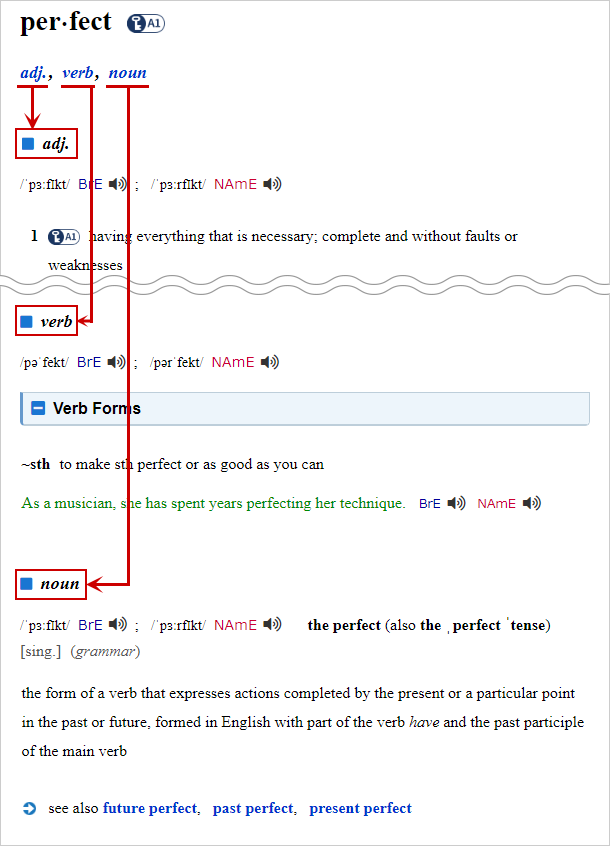
Squares show where the information each part of speech begins.
There are some words in English that have the same spelling as each other but different pronunciations.
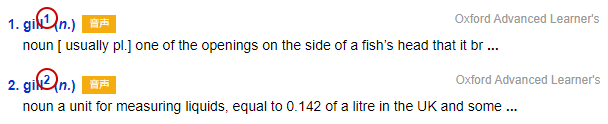
The small homonym number shows that this is the first of two headwords spelled gill.
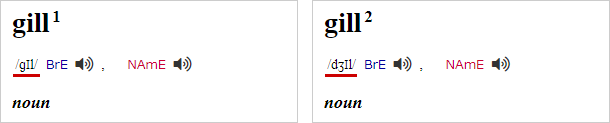
Different pronunciation is given at each headword.
There are also some words in English that have more than one possible spelling, and both spellings are acceptable. Information about these words is given at the most frequent spelling.
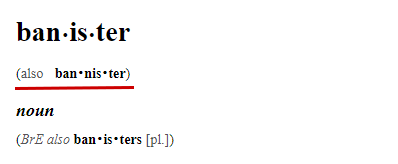
The variant spelling is given in brackets.
At the entry for the less frequent spelling a cross reference directs you to the main entry.
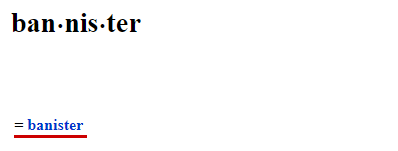
Irregular forms of verbs are treated in the same way.
Some words that are derivatives of other words do not have their own entry in the dictionary because they can be easily understood from the meaning of the word from which they are derived (the root word). They are given in the same entry as the root word, in a specially marked section.
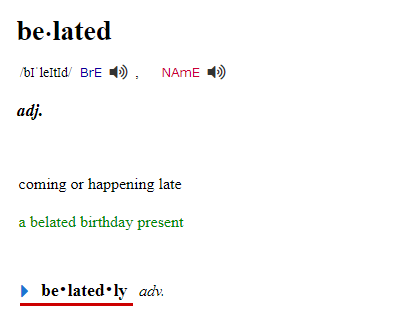
The blue triangle shows where the derivative section starts.
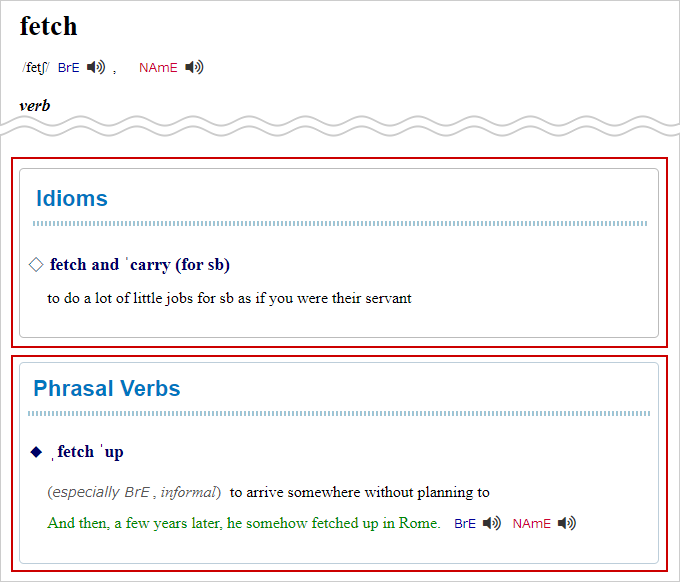
You can find idioms and phrasal verbs in separate sections, each enclosed in a separate frame.
Wordfinder notes help you to find words that you don’t know or have forgotten. They suggest entries that you can look up to find vocabulary related to the headword. For example, you will find this Wordfinder note at the entry for home.

Finding the meaning
Some words have very long entries. It is not usually necessary to read the whole entry from the beginning if you already know something about the general meaning that you are looking for.
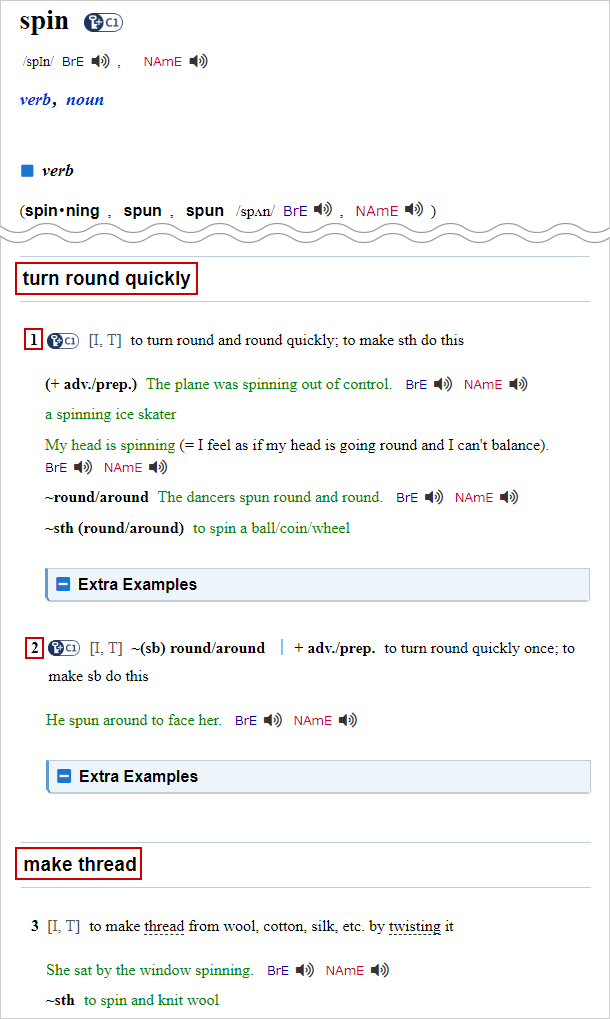
Shortcuts show the context or general meaning.
Meanings that are closely related share the same shortcut.
Understanding and using the word
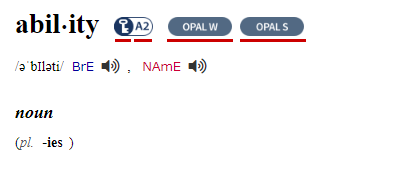
Word with a  symbol are part of the Oxford 3000 list of important words (see
Oxford 3000™ and 5000™
). The
symbol are part of the Oxford 3000 list of important words (see
Oxford 3000™ and 5000™
). The  tells you the CEFR level of the word. Small keys indicate which parts of the entry are most important.
Words from the Oxford Phrasal Academic Lexicon (OPAL) written and spoken word lists are marked with  and
and  (see
The Oxford Phrasal Academic Lexicon™
).
(see
The Oxford Phrasal Academic Lexicon™
).
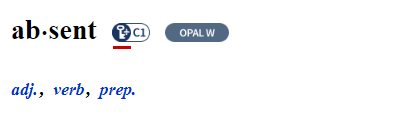
Words with a  symbol are part of the Oxford 5000 list of important words (see
Oxford 3000™ and 5000™
).
symbol are part of the Oxford 5000 list of important words (see
Oxford 3000™ and 5000™
).
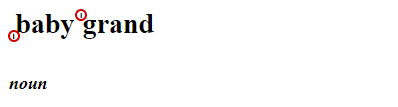
Stress marks show stress on compounds.
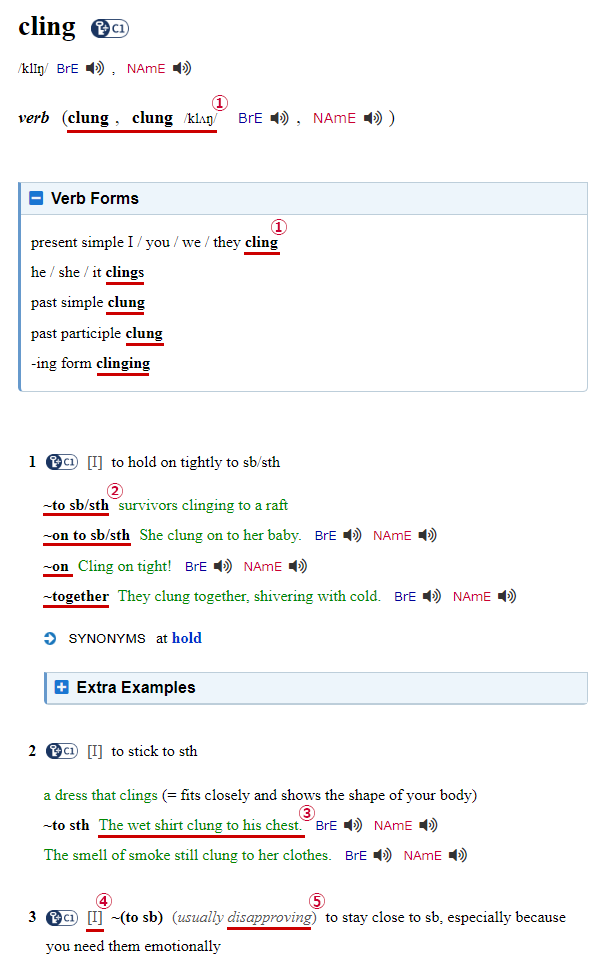
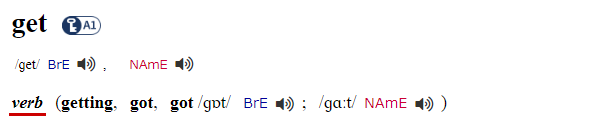
① Irregular forms of verbs, with their pronunciations.Irregular plurals of nouns are also shown.
② Prepropositions, adverbs and structures that can be used with this word
③ Examples of use are shown in green.
④ Verb code (see
Abbreviations used in the dictionary
)
⑤ Label giving information about usage (see
Labels used in the dictionary
)
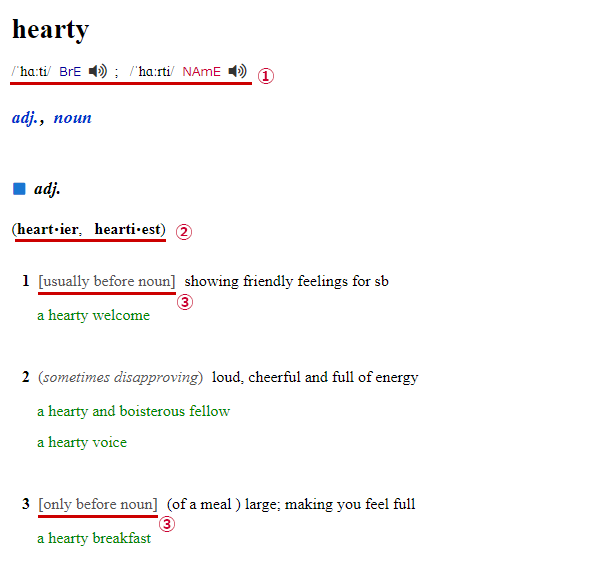
① Pronunciation, with American pronunciation where it is different
② Comparatives and superlatives of adjectives
③ Information on use of adjectives
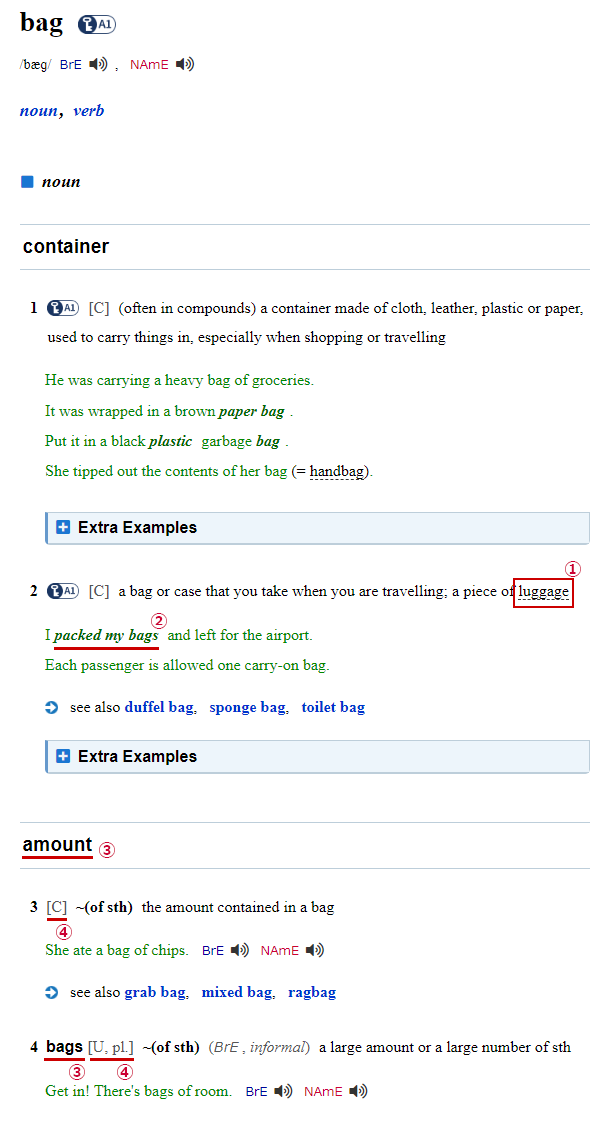
① Word used in definition that is not in the Oxford 3000
② Common phrase in bold type in example
③ Information on different types of noun
④ Fixed form of noun
Build your vocabulary
The dictionary also contains a lot of information that will help you increase your vocabulary and use the language productively.
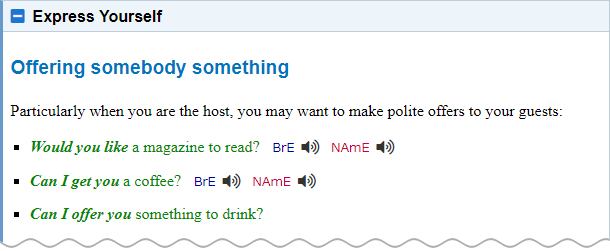
Language banks and Synonyms notes give useful vocabulary, especially for writing, and Express yourself notes help you find the right words in everyday situations.
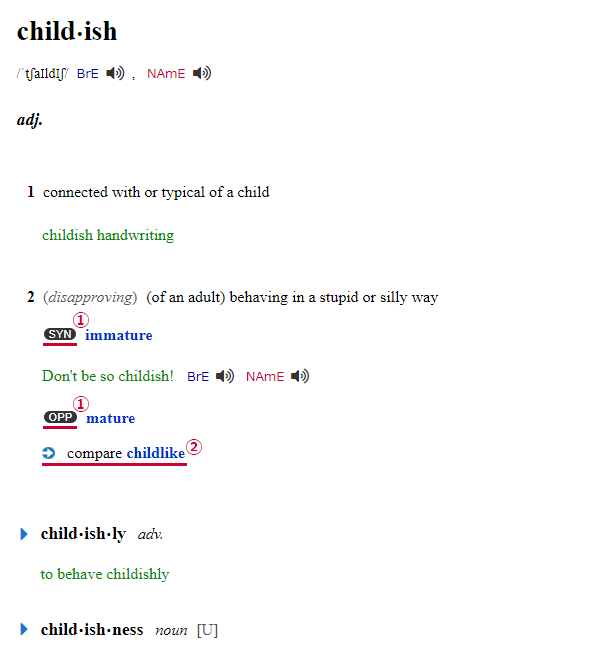
① Special symbols show synonyms and opposites.
② Cross references refer you to information in other parts of the dictionary, for example words that sometimes get confused with the word at this entry.
The Oxford 3000™ and Oxford 5000™
The Oxford 3000
The Oxford 3000 is a list of the 3,000 core words that every learner of English needs to know. The words have been carefully selected based on their frequency in the language and their relevance to learners. Every word has been assigned a level, from A1 to B2 on the CEFR, guiding learners from beginner to upper-intermediate level on the most important words to learn.
The frequency of the words was measured in the Oxford English Corpus (OEC). A corpus is an electronic database containing large numbers of written or spoken texts that can be searched, sorted and analysed. The OEC contains over 2 billion words from different subject areas and contexts, covering British, American and world English. Frequency is the most important criterion for deciding the importance of a word: the most frequent 2,000 words in English make up around 80 per cent of almost any English text.
The relevance of the words to English language learners was measured by their frequency in a specially created corpus of Secondary and Adult English courses published by Oxford University Press. This means that the list covers words that learners will come across in class and in their study texts, even if they are less frequent in a general corpus. These include, for example, words for everyday things and places (banana, cafe, T-shirt), words for describing feelings (amazed, annoyed, unhappy) and words connected with studying (dictionary, exam).
What is the CEFR?
CEFR stands for the ‘Common European Framework of Reference’ for languages, which is a description of the language abilities of students at different levels of learning. The CEFR can be used to compare standards in language learning and create teaching programmes.
It grades language skills at six levels:
- A1 and A2 indicate elementary and pre‑intermediate levels of ability.
- B1and B2 indicate lower- and upper‑intermediate levels.
- C1 indicates advanced level.
- C2 indicates complete proficiency in the language.
The CEFR grades language skills – what students can do in the language, for example ‘can understand the main ideas of complex text on both concrete and abstract topics’ (at B2). It does not grade specific grammar points or vocabulary items. However, we have aligned the words in the Oxford 3000 to the levels of the CEFR from A1 to B2 in order to guide learners of English on the most important words to learn at each level. These levels are based on the same criteria of frequency and relevance: the corpus of Secondary and Adult English courses enabled us to track the frequency of vocabulary items at each level of a course.
What is the Oxford 5000?
The Oxford 3000 is the core word list for learners up to B2/upper-intermediate level. The Oxford 5000 is an expanded core word list for advanced learners of English. It includes an additional 2,000 words at B2-C1 level on the CEFR, guiding advanced learners on the most useful high-level words to learn to expand their vocabulary.
Keywords in the dictionary
The words of the Oxford 3000 are shown in the main section of the dictionary in larger print and with a key symbol immediately following. The CEFR level for the core sense of the word is shown after the key. If he word has more than one meaning, a small key symbol will indicate each of the meanings that belong to the Oxford 3000. The CEFR level is shown for each of these meanings: some of the secondary meanings may have a higher level than the core sense.
The words of the Oxford 5000 are shown in the main section of the dictionary with a ‘key plus’ symbol and the CEFR level – B2 or C1 – for the core sense of the word. Again, if there is more than one meaning, there will be a key plus symbol and a CEFR level at each meaning that belongs to the Oxford 5000.
In order to make the definitions in this dictionary easy to understand, we have written them using the keywords of the Oxford 3000. Numbers and proper names are also used in definitions, as are a few language study terms, such as alphabet, noun and tense. When it has been necessary to use a specialist term that is not in the Oxford 3000, the word is shown in SMALL CAPITALS. Where appropriate, a GLOSS (= a short explanation of the meaning) of the specialist term is included in brackets.
The entries for all words in the Oxford 3000 have been re-edited for this edition, using the most up-to-date corpora. Many of these entries have been expanded in order to include more information about the most frequent collocations and examples of different grammatical patterns used with these words.
For more information on the Oxford 3000 and Oxford 5000, and to see the full lists, visit www.oxford3000.com.
The Oxford Phrasal Academic Lexicon™
What is OPAL?
The English spoken by a professor in a lecture hall is different from the English written in an academic paper – and both are different from everyday conversation between friends, or the language used in popular fiction. If you are a student of English for Academic Purposes (EAP), it is important to become familiar with the vocabulary that you will come across when attending lectures and seminars, and that you will need for writing essays and reports.
The Oxford Phrasal Academic Lexicon, or OPAL for short, is a collection of four word lists that together provide an essential guide to the most important words to know in the field of EAP. The four lists cover both written and spoken academic English, with lists of written words, spoken words, written phrases and spoken phrases.
The words and phrases in OPAL are based on two main corpora, to give learners a true picture of academic English. The written words and phrases are based on the 71-million-word Oxford Corpus of Academic English (OCAE), a corpus composed of academic texts published by Oxford University Press across these four subject areas: physical sciences, life sciences, social sciences, and arts and humanities. The spoken words and phrases are based on the British Academic Spoken English (BASE) corpus1. This corpus was developed at the Universities of Warwick and Reading and contains nearly 1.2 million words of spoken academic English, recorded and transcribed from lectures and seminars across the same four subject areas.
OPAL was developed using a method called ‘keyword analysis’. By comparing the list of the most frequent words and phrases in each corpus with the list of the most frequent words and phrases in a contrasting reference corpus, we identified the words and phrases that are most important in an academic setting. For the written lists, we compared the OCAE with the fiction subcorpus of the Oxford English Corpus. For the spoken lists, we compared the BASE corpus with the spoken subcorpus of the British National Corpus, containing recordings of meetings and everyday conversation.
OPAL in the dictionary and online
Words that belong to the OPAL written and spoken word lists are indicated in the dictionary by symbols next to the headword: indicates a word on the OPAL written word list; indicates a word on the OPAL spoken word list; and indicates a word on both the written and spoken word lists.
To see the full lists, visit www.opalwordlist.com. The written word list is divided into 12 sublists of 100 words each and the spoken word list is divided into 6 sublists of 100 words each. Sublist 1 of each list contains the most important academic words, with the next most important in Sublist 2, and so on.
It is often not the word itself that is ‘academic’, but the way it is used and combined with other words in an academic context. Therefore, besides the lists of single words, OPAL also includes a list of written phrases and a list of spoken phrases, which you can also find online. The phrase lists are grouped into academic functions. The written phrase list covers 15 different functions, including ‘Explaining and defining’ and ‘Giving examples and presenting evidence’. The spoken phrase list covers 16 functions, including ‘Signposting and focusing in lectures/lessons’ and ‘Using vague language’.
Whether you are using the print dictionary or accessing OPAL online (from which you can click through to the dictionary entries, either in the Oxford Advanced Learner’s Dictionary online or in the Oxford Learner’s Dictionary of Academic English), it is important to realize that learning a word involves more than just knowing its basic meaning. Some words may have specific meanings in particular contexts: for example, the word environment (in Sublist 1 of the written list and Sublist 2 of the spoken list) may have a slightly different meaning, depending on whether the area of study is ecology, social science or computing. The dictionary entry will guide you on all the different meanings and also how to use them in context, with examples of use, frequent collocations and patterns with grammatical structures or prepositions.
1 OPAL has been created with reference to the following corpora: the Oxford Corpus of Academic English (OCAE), the fiction subcorpus of the Oxford English Corpus (OEC), the spoken element of the British National Corpus (BNC) and a subset of the British Academic Spoken English (BASE) corpus, developed within the University of Warwick and for which relevant permissions have been obtained. BASE was developed at the Universities of Warwick and Reading under the directorship of Hilary Nesi and Paul Thompson. Corpus development of BASE was assisted by funding from BALEAP, EURALEX, the British Academy and the Arts and Humanities Research Council.
Labels used in the dictionary
The following labels are used with words that express a particular attitude or are appropriate in a particular situation.
approving expressions show that you feel approval or admiration, for example feisty, petite.
disapproving expressions show that you feel disapproval or contempt, for example blinkered, newfangled.
figurative language is used in a non-literal or metaphorical way, as in He didn’t want to cast a shadow on (= spoil) their happiness.
formal expressions are usually only used in serious or official language and would not be appropriate in normal everyday conversation. Examples are admonish, besmirch.
humorous expressions are intended to be funny, for example fisticuffs , ignoramus.
informal expressions are used between friends or in a relaxed or unofficial situation. They are not appropriate for formal situations. Examples are bonkers, dodgy.
ironic language uses words to mean the opposite of the meaning that they seem to have, as in You’re a great help, I must say! (= no help at all).
literary language is used mainly in literature and imaginative writing, for example aflame, halcyon.
offensive expressions are used by some people to address or refer to people in a way that is very insulting, especially in connection with their race, religion, sex or disabilities. You should not use these words.
slang is very informal language, sometimes restricted to a particular group of people, for example people of the same age or those who have the same interests or do the same job. Examples are dosh, gnarly.
specialist language is used by people who specialize in particular subject areas, for example accretion, adipose.
taboo expressions are likely to be thought by many people to be very offensive or shocking. You should not use them.
The following labels show other restrictions on the use of words.
dialect describes expressions that are mainly used in particular regions of the British Isles, not including Ireland, Scotland or Wales, for example beck, nowt.
old-fashioned expressions are passing out of current use, for example beanfeast, bothersome.
old use describes expressions that are no longer in current use, for example ere, perchance.
saying describes a well-known fixed or traditional phrase, such as a proverb, that is used to make a comment, give advice, etc., for example actions speak louder than words.
™ shows a trademark of a manufacturing company, for example Band-Aid, Frisbee.
Abbreviations and Symbols used in the dictionary
Abbreviations used in the dictionary
| abbr. | abbreviation |
| adj. | adjective |
| adv. | adverb |
| C | countable noun |
| conj. | conjunction |
| det. | determiner |
| I | intransitive verb |
| n. | noun |
| pl. | plural |
| past part. | past participle |
| prep. | preposition |
| pron. | pronoun |
| sb | somebody |
| sing. | singular |
| sth | something |
| symb. | symbol |
| T | transitive verb |
| U | uncountable noun |
| v. | verb |
| AustralE | Australian English |
| BrE | British English |
| CanE | Canadian English |
| EAfrE | East African English |
| IndE | Indian English |
| IrishE | Irish English |
| NAmE | North American English |
| NEngE | English from Northern England |
| NZE | New Zealand English |
| SAfrE | South African English |
| ScotE | Scottish English |
| SEAsianE | South-East Asian English |
| US | English from the United States |
| WAfrE | West African English |
| WelshE | Welsh English |
Symbols used in the dictionary
 | derivative(s) section of an entry |
| ~ | replaces the headword of an entry |
| a part of speech | shows new part of speech in an entry |
| derivative | derivative(s) section of an entry |
| • | in headword (af•fect), shows where a word can be broken |
| ⇔ | in phrasal verbs, shows that the object may come either before or after the particle |
| opposite | shows an opposite |
| synonym | shows a synonym |
| idiom | shows idiom(s) |
| shows a word from the Oxford 3000 (see page Oxford 3000™ ) |
| shows a word from the OPAL written word list (see The Oxford Phrasal Academic Lexicon™ ) |
| shows a word from the OPAL spoken word list (see The Oxford Phrasal Academic Lexicon™ ) |